
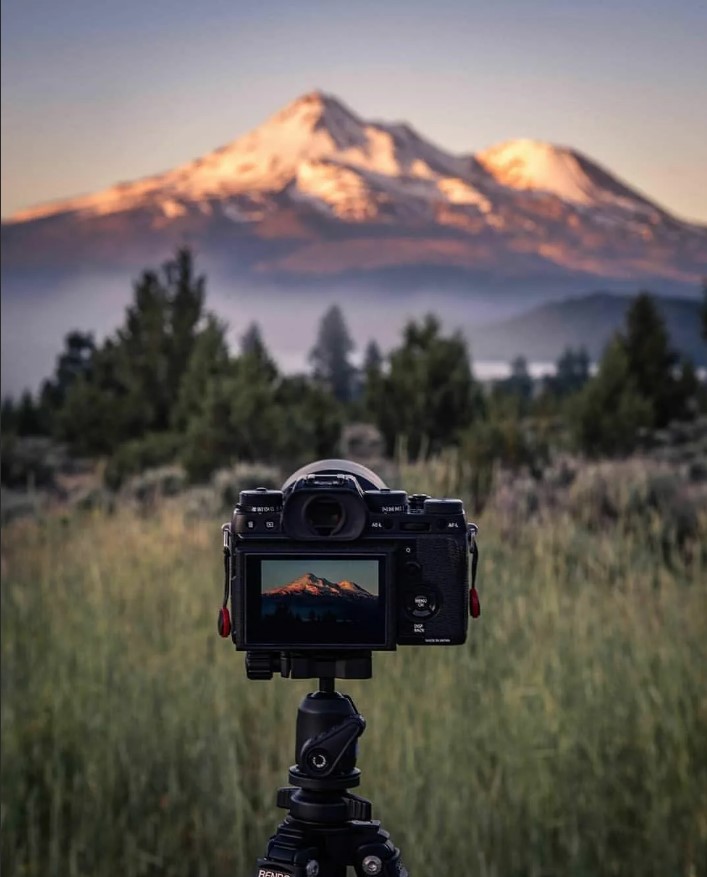
If you are planning to buy a camera, you will inevitably be overtaken by the question “Which is better to buy: a volumetric SLR or a small digital one?”. For users of photographic equipment, this dilemma remains relevant to this day, no matter how many new improved models appear. To make the right choice and not regret it later, the first step is to decide on your shooting needs. They will largely determine the outcome of your decision.
In our time of advanced gadgets, you can take a good picture even on a regular smartphone. Therefore, a reasonable decision would be to opt for the best quality. Good pictures can be obtained both on a digital and on a SLR camera, if we compare representatives of the same price segment.
The parameters and weight of the camera is a very important aspect that you should pay special attention to, because it is the main difference between a compact and a DSLR. Do you expect to carry a camera bag with a heavy DSLR and lens at work, or would you prefer a camera that fits easily in your pocket? For most amateur photographers, this criterion is decisive.
With the fact that you mainly want to photograph, it is better to decide in advance. This will help you avoid disappointment in the properties of already purchased equipment, because each camera model is created for its specific tasks. For example, for shooting at night, a SLR camera is more suitable, as it will provide image quality at a level higher than digital.
The SLR camera has a built-in viewfinder, which is based on a mirror. In stores, we can find twin-lens and single-lens reflex devices. The mirror in them is at an angle of 45 degrees, which allows you to see in the viewfinder not a digitized, but a real image. Light entering through the lens is reflected by the mirror and directed upwards into the pentamirror, which correctly orients the image so that it is not upside down. It turns out that the distinctive feature of mirror equipment is the presence of a viewfinder. Such a camera also has an additional monochrome display, especially large devices, they have good access to all buttons, wheels and other shooting controls. The main advantage of a DSLR is, of course, a large arsenal of features offered. With it, you can achieve more “complex” and high results: fireworks, sunsets, sunrises, night views - everything that looked like a big incomprehensible spot of light when shooting on a digital camera or smartphone, will acquire a silhouette, shape and natural color. You will be able to get photos with high detail, without “glare”, noise and other defects. Filters, functions, lighting settings, compositions and other delights of SLR cameras will become available to you. Thanks to this, you will be able to choose the color palette of your photo, saturation, brightness and other parameters, which will allow you to take exactly the picture you imagine. In addition, you can expand the capabilities of your camera by purchasing various lenses.
The main reason why people prefer a SLR camera is the high level of quality and clarity of images. With the same number of pixels, a DSLR will provide you with photo quality that will be several levels higher than the quality of digital camera frames. The reason for this is better optics and a matrix.
There is a downside to using a DSLR. It is not as obvious as the first two, but sometimes it presents great inconvenience to the owners of this technique. Changing lenses is not a one-second process, and it is far from always possible to carry it out. For example, you are shooting plants and insects in the forest, having fixed a lens for close distances on the camera, and suddenly a roe deer appears in the distance, which is about to hide behind the trees again. The environment can prevent you from changing lenses quickly and you will miss your only chance by not capturing this beautiful animal. It is not so easy to rearrange the lenses, because you need to avoid getting dirt, dust and moisture on the matrix as much as possible.
The advantages of compact cameras are just the shortcomings of SLRs. Their low cost and miniature dimensions are an undoubted advantage for them. Digital devices are very easy to carry. It is convenient to take them with you on trips and excursions, they will always be at hand, and will allow you not to miss an interesting moment.
The main disadvantage of a digital photo device can be considered a weak matrix. The quality of the resulting image depends on it. To this day, many people are convinced that a large number of pixels is necessary to obtain a high-quality image. But this is a big misconception. For a regular 10x15 photo, 3.2 megapixels is enough. Once upon a time, such a number of Mn was the most common. Now, basically, photography is done at 12-20 megapixels.
The second disadvantage of digital cameras is the weak optics built into them. Unfortunately, the laws of optics do not allow us to get super high-quality images using the small lens that compact devices have. We add that the lenses on digital cameras are quite dark, which means they have a weak aperture ratio. It also does not affect the quality of the photo in the best way.
So, we found out that there is no single answer to the question “Which camera is better: SLR or digital”, because each of them has its own unique features and functions. Therefore, before making a choice in favor of one of the presented options, carefully read the pros and cons of both devices. Be extremely objective to yourself, realistically assess your needs and opportunities. Based on the selection criteria and find out what suits you personally: the convenience of using a miniature digital camera with simple photos in the end, or bulky, heavy equipment, but high-quality pictures.